
A cheap set of headers on a 350 announces itself within a week. The flanges tick, the coating burns off in the driveway, and the collector bolts loosen so often you keep a wrench in the glovebox, which is why picking the best exhaust headers for chevy 350 is worth some homework.
Thickness and material carry most of the decision. A 3/8-inch flange resists the warping that turns 1/4-inch plates into leak machines after a few heat cycles, and 16-gauge tubing, ceramic-coated steel or 409 stainless, outlasts the 18-gauge bargain stuff.
Primary size matters too: 1-1/2 inch tubes suit a mostly stock 350, while a hotter cam wants 1-3/4. Fit counts as well, so check clearance around the steering linkage and starter before anything goes on the engine.
Need a Quick Check?
| Image | Product | Price |
|---|---|---|
Our Top Picks 1 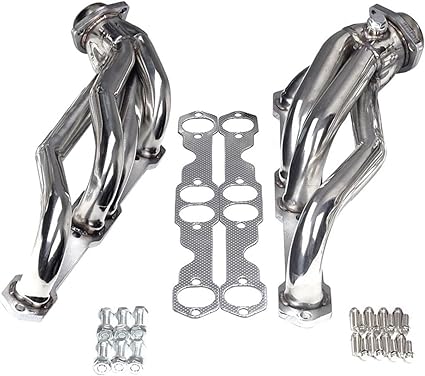 | C/K Truck Headers | Check Price |
Our Top Picks 2  | Classic Chevy Headers | Check Price |
Our Top Picks 3  | OBS Truck Headers | Check Price |
Our Selected Top 12 Exhaust Headers for Chevy 350 for Different Needs
The list covers twelve exhaust headers built for the Chevy 350, ranging from shorty designs for stock setups to long tubes for modified engines. Each review covers real-world performance, fitment, and sound, then sums up who the header suits along with its strengths and drawbacks.
1. Exhaust Headers for Chevy GMC C/K 1500 2500 5.0L 5.7L
These TEWOLISES headers swap out the restrictive stock manifolds on 1988-1995 Chevy and GMC trucks with the 5.0L or 5.7L V8. They suit hands-on C/K pickup, Blazer, Tahoe, and Yukon work. The thick laser-cut head flange is the standout, since thin flanges are where exhaust leaks usually start.
Ordering starts with a fitment check, since Amazon’s Your Garage feature matches your exact year and engine to the list. This set covers 1988-1995 C1500, C2500, K1500, and K2500 trucks with the 305 5.0L or 350 5.7L, plus 1992-1995 Blazer, Tahoe, Suburban, and Yukon variants.
On the truck, the bolt design lines up with the stock manifold positions, so you work through familiar mounting points and keep your standard exhaust connected. A recheck of the header bolts after a few heat cycles is smart practice.
The main job is moving exhaust away from the small block without leaks, and the build backs that up. The head flange comes laser-cut from 7/16-inch (11.5mm) steel plate, which stays flat and sealed under high-temperature conditions.
The pair weighs 16.07 pounds, so the tubing and flanges read as real steel rather than thin tin. The seal holds tight where the flange meets the head, but the polished finish needs regular wiping to keep its shine.
Each flange is laser-cut from 7/16-inch steel, which resists warping better than thin stampings. Installation means unbolting the stock manifolds and working wrenches in tight spaces. Re-torque every bolt after a few drives once the metal cycles hot and cools. Expect a deeper sound than the cast manifolds give, and seat the gaskets square or small leaks appear.
Anyone refreshing an older work truck, replacing a cracked manifold, or wanting a stronger sound from a tired 350 will get along with it fine. Among budget exhaust headers for Chevy 350 builds, the fitment covers 1988 through 1995 trucks plus Blazer, Tahoe, Suburban, and Yukon models. Skip them on 1996 and newer Vortec engines, and check emissions rules first.
The 16-pound package arrives with polished tubes that wipe clean with soapy water. Fresh gaskets, thread lubricant, and a torque wrench make the difference between a seal that lasts and one that starts ticking. Penetrating oil on stubborn manifold bolts the night before saves headaches. One afternoon in a driveway with hand tools is enough to finish the swap.
Pros
- 7/16-inch laser-cut flange holds a leak-free seal
- Bolt-on fit to stock manifold locations simplifies installation
- Covers 1988-1995 C/K pickups, Blazer, Tahoe, Suburban, Yukon
- Polished exterior looks clean in an open engine bay
Cons
- Fitment limited to listed 1988-1995 5.0L and 5.7L engines
- Polished finish needs periodic wiping to stay bright
| Specification | Details |
|---|---|
| Brand | TEWOLISES |
| Item model number | EH28628 |
| Item weight | 16.07 pounds |
| Package dimensions | 22 x 12 x 5.5 inches |
| Flange thickness | 7/16-inch (11.5mm) steel plate |
| Exterior | Polished |
2. Exhaust Headers for 1967-1987 Chevy Small Block V8
This is a set of polished stainless headers for 1967-1987 Chevy small block V8s, sized for the 262 through 400 including your 350. It fits the rebuild crowd, C10 pickups, Camaros and hot rods included. Its biggest strength is genuine stainless construction, the kind that resists the rust ruining mild steel exhaust parts.
Bolting a set on is a driveway job with the truck on jack stands. The CNC-machined ports and burr-free edges line up with the head, so you are not filing or reaming anything. At 22 pounds the set is easy to guide into place from underneath without a helper.
Past installation, upkeep is simple: wash it like paint, keep salt spray rinsed off, and re-torque the header bolts after the first few heat cycles.
Rust is the headline. The 304 stainless carries 50% higher corrosion resistance than ordinary steel, and the difference shows on vehicles that sit outside through wet winters.
TIG-welded joints run continuous rather than tacked, so seams hold together as the metal heats and cools. The polish gets compliments at shows but dulls fast once road grime bakes on. Warranty coverage runs 5 years against the 1-year industry average, with lifetime technical support.
Daily use starts with a straightforward bolt-on install along the factory flange pattern, though the tight space near a truck steering box makes wrench access slow. The polished 304 stainless tubes wipe back to a shine with a damp rag, and the CNC-cut flanges seat flush against new exhaust gaskets. Check the flange bolts again after a few heat cycles.
Builders refreshing a 350 in a C10 truck or older Camaro will be happy with the mirror finish and the wide fit across 262 through 400 cubic inch engines. Skip them for a built race motor that needs specific tuned tube lengths, or for tight swaps where ground clearance and steering linkage room matter more than shine.
Mind the details in the paperwork, too. The listing promises a five-year warranty with free replacement for defects and lifetime technical support, which stretches well past the typical one-year coverage at this price. At 22 pounds with a shipping box measuring 26.38 by 16.93 by 5.91 inches, the kit feels like more than a bare-bones bargain.
Pros
- 304 stainless with 50% higher corrosion resistance
- TIG-welded joints and burr-free CNC-machined edges
- 5-year warranty against the 1-year industry average
- Lifetime technical support included
Cons
- Generic brand with no established name behind it
- Fits 1967-1987 castings only, verify head bolt pattern
| Specification | Details |
|---|---|
| Material | 304 stainless steel, polished exterior |
| Engine compatibility | Chevy Small Block V8 262, 265, 267, 283, 302, 305, 307, 327, 350, 400 |
| Model years | 1967-1987 |
| Item weight | 22 pounds |
| Package dimensions | 26.38 x 16.93 x 5.91 inches |
| Manufacturer part number | Z001038O |
3. Exhaust Headers for Chevy GMC C/K 5.0/5.7 V8 1988-1997
Tubular replacement headers for 1988-1997 Chevy and GMC trucks with the 5.0 or 5.7 V8. They suit anyone reviving an aging C/K, whether the truck snapped a manifold bolt or needs a fresh exhaust setup. The standout feature is 304 stainless steel with TIG welds and CNC-machined flanges, backed by a 5-year warranty.
Bolt-up work happens under the truck through the front wheel wells, roughly like swapping stock manifolds. A direct-fit pattern keeps stock mounts and pipe connections, so the job needs common wrenches more than special tools.
Day to day, the TIG-welded seams take repeated heat cycles without complaint, and the polished exterior cleans with soap and water after a salt season. Fitment runs year-specific per body style, so check the list against your truck first.
The 304 stainless earns its keep through salted winters, standing up where stock manifolds crack and leak. TIG welding produces high-strength joints at every connection, and CNC machining holds the flange to exact tolerances for a solid head seal. The polished finish wipes back to a shine after gravel road dust.
Weld quality and the finish draw the most praise, but the fitment sheet cuts most body styles off at 1995, leaving only the C1500 covered through 1997.
Reviews are scarce, so a typical stretch of use looks like this. Bolt-up on a worn TBI 350 goes smoother with fresh gaskets and the torque sequence from a shop manual. The CNC-machined flanges sit flat, which helps the seal hold the first time. A startup tick fades once you re-torque the bolts after a few heat cycles.
Anyone rebuilding a C1500 or Yukon on a budget will be happy, especially people chasing down an exhaust leak on a 5.7 with bad manifolds. Trucks that tow heavy several times a month might want thicker flanges instead. Drivers in strict emissions states should check the paperwork first, since this listing never mentions CARB approval.
On any shortlist of the best exhaust headers for chevy 350 trucks, this one earns a spot for the 304 stainless and TIG-welded joints. The polished finish will scuff near the frame rails, so keep that in mind. A 5-year warranty backs it, and part number LXH001059 covers C1500, K2500, Blazer, Tahoe, and Yukon applications.
Pros
- 304 stainless resists rust through salted winters
- TIG welds create strong, leak-free joints
- 5-year warranty outlasts typical parts coverage
- Polished finish wipes clean with soap and water
Cons
- Most body styles lose fitment after 1995
- No gaskets or mounting hardware mentioned in the listing
| Specification | Details |
|---|---|
| Model | Fits Chevy GMC 5.0/5.7 V8 C/K truck 1988-1997 |
| Exterior | Polished |
| Brand | Generic |
| Manufacturer | LXH Power Autoparts |
| Manufacturer Part Number | LXH001059 |
| Package Dimensions | 22.44 x 11.81 x 5.91 inches |
4. Shorty Exhaust Headers for Chevy S10 S15 Blazer V8

These shorty headers fit Chevy S10, S15 and Blazer trucks running 283 to 400 V8 small blocks, including the 350. They suit anyone doing a swap or manifold replacement who wants extra flow without cutting or welding. The direct bolt-on fit is the standout trait, and 304 stainless resists rust better than bare mild steel.
Installation stays simple: unbolt the factory manifolds, set these in place, and fasten them with the included screws and nuts. The double-layer high-temperature ceramic carrier handles exhaust heat while keeping airflow moving, which plays into the power and economy gains the maker promises. Have a fresh set of header gaskets ready, since the box lists only fasteners.
Before ordering, match the part number to your model year and engine displacement.
Shorty headers keep things simple under the hood of an S10 with a 350, and the maker credits the double-layer ceramic carrier with more power and better fuel efficiency. The 304 stainless build is the strong point, refusing to rust the way mild steel does after wet winters. The bolt-on install works as described, with no cutting or modification needed.
One hard limit applies: the set is not CARB certified, so it cannot ship to California or go on emission-spec vehicles there.
The listing shows one review, five stars, so this mostly comes down to everyday behavior. These shorty headers follow the stock manifold bolt pattern, which keeps a Chevy 350 swap workable around the S10 steering shaft. The idle runs louder and sharper than cast iron, and the flange bolts deserve a re-check after the first few heat cycles.
Budget builders dropping a 283 through 400 small block into an S10 or S15 Blazer are the natural match, especially anyone replacing cracked cast manifolds without cutting or welding. Skip this one in California, where it cannot legally ship or install without CARB certification, and skip it if you want every last horsepower from long-tube headers.
The set is 304 stainless with a double ceramic layer, and the included hardware covers screws and nuts only. Gaskets are not on that list, so buy a set before teardown day. Pmxloes backs it with a three-year warranty, and matching part number GF-EXH-0720 against your old manifolds prevents an ordering mistake.
Pros
- Bolt-on design, no cutting or modification required
- 304 stainless steel resists rust for years
- Double-layer ceramic carrier improves airflow and economy
- Backed by a 3-year manufacturer warranty
Cons
- Not CARB certified, cannot ship or install in California
- Only screws and nuts included, gaskets not supplied
| Specification | Details |
|---|---|
| Brand | Pmxloes |
| Material | 304 stainless steel |
| Engine compatibility | Chevy 283, 302, 307, 327, 350 and 400 V8 |
| Included components | Screws and nuts |
| Manufacturer part number | GF-EXH-0720, model GFGXS-108 |
| Warranty | 3 years |
5. Stainless Steel Exhaust Headers for Chevy SBC 350

This is a stainless steel header set for the Chevy small block V8 family, including the workhorse 350. It suits a garage build, an older truck or a restoration where the stock manifolds have to go, and its biggest strength is real 304 stainless construction at a budget price.
Setup starts with homework, not tools. Match your model year and port layout against the listing before ordering, since the set covers small blocks from the 262 up through the 400. The shipping box runs 26 x 17 x 5.5 inches and weighs 21 pounds, easy to shelve in the garage until install day.
On the engine, start every flange bolt by hand before final torque so the flanges seat flat against the head faces. Routine care afterward is a wipe-down to keep the finish bright.
Mandrel bending keeps tube diameter consistent through each curve instead of crushing it, and the TIG welds sit where headers usually fail, at the flanges where the tubes meet the head. The 304 grade fights rust far better than the painted mild steel found on cheaper sets.
The strongest praise concerns the welds and the polish, which read above what the price suggests. The common complaint is fitment, because the compatibility list carries exceptions and the port arrangement has to line up with your heads exactly.
On a stock 350, these bolt up to the factory exhaust flanges and let the engine breathe better than cast iron manifolds allow. The 304 stainless tubes shrug off the surface rust that eats cheaper mild steel headers over salty winters. The polished finish needs only soapy water and a soft cloth to stay bright.
Anyone rebuilding a small block from the 262 through the 400 for a street truck, Chevelle swap or hot rod will be happy here. Skip the 1989 Camaro RS, which the fitment list excludes, and skip a race build needing custom tube lengths or ceramic coating. Check your model year and flange layout against the listed engines before ordering.
Plan on a weekend afternoon for the swap. New exhaust gaskets make a difference, since reused ones rarely seal against a polished flange. Tighten the flange nuts in stages and re-check them after the first few heat cycles, because stainless expands more than the cast iron you removed. A deep socket keeps those studs from rounding.
Pros
- Real 304 stainless, not coated mild steel
- Mandrel bends keep the tube diameter steady
- TIG welded construction across the set
- After-sales support offered for fitment questions
Cons
- No fitment for the 1989 Chevrolet Camaro RS
- Fitment needs checking against model, year and interface
| Specification | Details |
|---|---|
| Material | 304 stainless steel |
| Construction | Mandrel bent, TIG welded, polished finish |
| Engine fitment | Small block Chevy V8 262, 265, 283, 305, 327, 350, 400 |
| Compatibility note | Not for the 1989 Chevrolet Camaro RS |
| Item weight | 21 pounds |
| Package dimensions | 26 x 17 x 5.5 inches |
6. Exhaust Headers for 1982-1992 Camaro Firebird V8

These headers replace the restrictive stock manifolds on a 1982 to 1992 Camaro or Firebird V8. They suit someone keeping a third-gen F-body mostly stock who wants more grunt without touching the rest of the exhaust.
The biggest strength is the true bolt-on fit, since they connect straight to your existing exhaust pipes.
You unbolt the stock manifolds, seat these against the heads with fresh gaskets, and bolt them to your existing pipes, so there is no pipe cutting or bending. The 5/16-inch flange is laser-cut and pressed flat, which helps it sit square and seal against the head. Wrench room around the rear cylinders is tight on these cars, so expect a fiddly job.
Once in, the hi-temp black paint takes the heat at idle and during normal driving.
The tubes are mandrel bent from 16-gauge cold roll steel, so the inside diameter stays consistent with no pinch points. All joints are TIG welded, which keeps cracking and wear down where cheaper work tends to let go.
Power comes on from idle through the mid-range, exactly where a street car lives. The welds and 5/16-inch flange stay solid over time, but the paint can discolor or burn off near the hottest ports.
These headers replace the stock manifolds on a 1982 to 1992 Camaro or Firebird V8 and bolt to the factory exhaust pipes with no cutting. The mandrel bent 16-gauge tubes keep their diameter through every bend, and the gains show up from idle through mid-range rpm. Basic hand tools handle the install since everything lines up with factory mounting points.
Anyone with a third-gen F-body running a stock or mildly built 350 who wants low-end response without touching the exhaust will be happy here. The black paint and steel construction suit a budget build. Racers chasing peak horsepower up high, or anyone wanting ceramic finishes or CARB certification for a strict inspection state, should spend more on a premium set.
Keep a set of new manifold gaskets on hand before starting, since old hardware tends to seize. Retorque the flanges after a few heat cycles. Check the welds and paint yearly for rust, especially where roads get salted. For the price, this is a straightforward upgrade that wakes up an older Chevy 350 without complicating the exhaust.
Pros
- Direct bolt-on for stock manifolds and pipes
- Mandrel bent 16-gauge mild steel tubes
- TIG welded joints resist cracking and wear
- Paint handles heat up to 932F
Cons
- Paint needs touch-ups around the hottest ports
- No gains claimed above mid-range RPM
| Specification | Details |
|---|---|
| Brand | PG POWERGO MOTORSPORT |
| Manufacturer | PowerGo Motorsport |
| Item weight | 20 pounds |
| Product dimensions | 23 x 15 x 10 inches |
| Exterior | Hi-temp Black Paint |
| Manufacturer part number | 4AC5CE4018 |
7. Long Tube Exhaust Headers for 1988-1999 Chevy GMC C/K V8

Long tube headers for 1988-1999 Chevy GMC C/K trucks with the 5.0L or 5.7L small block V8. This dmanauto set uses 1-5/8 inch primaries, a 2.5 inch collector, and polished 304 stainless.
Its strongest point is build quality: TIG welds and CNC machined flanges that stay tight under heat. It suits anyone refreshing an older truck.
Installation is a standard under-the-truck job: unbolt the manifolds, lift the set into place, and work from below with basic sockets. The CNC machined flanges sit flat, so gaskets seat evenly and the seal holds through repeated heat cycles. The 2.5 inch collector expects a matching exhaust, and stock single pipes may need an adapter.
At 27.7 pounds it is a solid one-person fit with a floor jack. The polished finish needs wiping with metal polish to stay bright.
The 1-5/8 inch primaries and 2.5 inch collector move exhaust out faster than the stock cast manifolds, which is what frees up breathing on a tired 5.7L. TIG welded seams resist the cracking that spreads on cheaper headers through heat cycles, and 304 stainless handles road salt better than plain steel.
Machined flanges stay flat, and that is what keeps cold-start tick away. The main limit is fitment: it bolts to 5.0L and 5.7L small block V8s only, and the model label cites an LS swap variant with 1 7/8 inch tubes, so verify part number 6098c10 before ordering.
Day to day, these headers trade the cast manifold’s muted hum for a sharper, straighter exhaust note. Polished stainless holds up in rain but tends to show heat tint near the collectors, so a wipe with metal polish keeps it tidy. Plan on fresh gaskets and a 2.5-inch mid-pipe to mate the collectors to the rest of the system.
Drivers with a stock or lightly modified 5.0 or 5.7 small block will be happiest, since 1-5/8-inch primaries match factory-style breathing. Anyone running a built 383 stroker should step up to 1-3/4-inch tubes, and a lowered 2WD daily that scrapes driveways is better served by shorty headers with a compact profile. Check clearance around the steering shaft before ordering.
Shoppers comparing the best exhaust headers for chevy 350 projects will notice this set sticks to the basics: 304 stainless, TIG welds, CNC-machined flanges, and a listed 27.7 pounds. One catch in the listing: the model name says 1-7/8-inch tubes while the description says 1-5/8-inch, so confirm sizes with the seller first. That mismatch is worth an email.
Pros
- Polished 304 stainless resists rust through salted winters
- TIG welded seams resist cracking from heat cycles
- CNC machined flanges seat gaskets flat for a tight seal
- Works on both 2WD and 4WD C/K trucks
Cons
- Bolts only to 5.0L and 5.7L small block V8s
- Model label cites an LS swap variant with 1 7/8 inch tubes
| Specification | Details |
|---|---|
| Primary tube size | 1-5/8 inch |
| Collector size | 2.5 inch |
| Material | Polished 304 stainless steel, TIG welded |
| Fitment | 1988-1999 Chevy GMC C/K, 2WD & 4WD, 5.0L/5.7L V8 |
| Item weight | 27.7 pounds |
| Part number | 6098c10 |
8. Exhaust Headers for Chevelle, El Camino, Nova V8

These tubular headers from PG Powergo Motorsport replace the stock manifolds on a Chevelle, El Camino, or Nova with a V8. They suit anyone building a street 350 who wants more power without custom fabrication work. The biggest strength is fitment: they bolt on in place of the factory iron and connect to stock exhaust pipes as-is.
Installation mirrors a manifold swap: unbolt the old manifolds, seat the flanges against the heads, and join the tubes to the pipes you already have. At 23 pounds for the set, positioning them under the car is a one-person job.
The mandrel bends hold a consistent 16-gauge (1.5mm) wall through every turn, so exhaust gas keeps its velocity instead of choking at each kink. Daily driving is where the gain shows up, from idle through mid-range RPM, the band a street engine lives in.
Build quality shows in the details. The flange is laser-cut from 5/16-inch (8.0mm) plate and flattened under a hydraulic press, which keeps the sealing surface flat so gaskets seat evenly.
Every joint is TIG welded, giving good resistance against the cracking and wear that heat cycles cause. The finish is the trade-off: paint rated to 932F can burn off around the hottest ports, and the mild steel underneath will surface-rust wherever the coating lets go.
Swapping out the stock manifolds on a small block Chevelle, Nova, or El Camino is a plain bolt-up job with this set. The tubes are mandrel bent from 16-gauge cold roll steel, about 1.5mm thick, and the laser-cut flanges run 5/16 inch. Gains show up from idle through mid-range rpm, where street cars spend most of their time.
Anyone hunting the best exhaust headers for Chevy 350 street machines should keep this set on the short list. It bolts directly to stock exhaust pipes, which suits daily drivers and weekend cruisers running a small block. Pick stainless or ceramic-coated headers instead if you want polished looks or a build that lives up high in the rev range.
The TIG welded joints resist cracking and the black hi-temp paint is rated to 932 degrees Fahrenheit. At 23 pounds per set, these are easy to maneuver under a car on jack stands. Keep in mind the steel is mild, so scratches from wrenches can show light rust eventually; keep a can of high-temp paint for touch-ups.
Pros
- Bolts to stock pipes with no cutting or welding
- Thick 5/16-inch flanges resist warping and gasket leaks
- TIG-welded joints resist cracking and wear under heat
- Gains from idle through mid-range RPM
Cons
- Mild steel rusts wherever the paint chips or burns away
- Gains taper off above mid-range on high-revving builds
| Specification | Details |
|---|---|
| Brand | PG Powergo Motorsport |
| Compatibility | Chevelle, El Camino, and Nova V8 |
| Tube material | 16-gauge (1.5mm) cold roll flash mild steel, mandrel bent |
| Head flange | Laser-cut 5/16-inch (8.0mm) steel plate |
| Finish | Hi-temp black paint, rated to 500C (932F) |
| Product dimensions | 31 x 11 x 10 inches |
9. Exhaust Header Kit for Chevy GMC S10 S15 Blazer 350 V8

This is a stainless steel header kit for an S10 or S15 truck running a swapped Small Block Chevy V8. It suits anyone dropping a 350 into a 2WD S10 Pickup, Blazer, Jimmy, or Sonoma.
Its biggest strength is the tube routing, which was laid out around those truck chassis so the pipes actually clear everything under there.
Setup is easier than most header kits because the box includes left and right headers, gaskets, collector flanges, and the mounting hardware. The flanges come machined flat, so the bolt holes sit square against standard SBC heads without forcing anything into line.
The mandrel bends stay smooth inside, so each tube holds its opening through every turn instead of kinking down. A TH350 automatic works, but only with a floor shifter, so check your shifter type before ordering.
The build combines stainless tubing, welded joints, machined flanges, and clean bends throughout. The 5.0 star rating is strong, though it rests on a single review, so there is not much long-term feedback to lean on yet.
The clearest weaknesses come from the fitment list itself: angle-plug cylinder heads get no support, and column-shift setups are not covered by the TH350 clearance.
These headers bolt onto a swapped small block in a 2WD S10 with the collector flanges lining up close to the stock exhaust position. The kit arrives with gaskets and all the mounting bolts, so the swap needs fewer extra parts runs. Mandrel-bent stainless tubes keep the welds neat, and the single published rating sits at five stars.
Anyone dropping a 350 into a 2WD S10, Sonoma, or Blazer alongside a TH350 with a floor shifter will be glad this exists, since the tubes are bent for that chassis clearance. Run angle-plug heads, a column shift, or a 4WD truck, and a different header is the smarter buy. Standard heads only.
Flanges come machined flat, which helps the gaskets seal on a fresh swap without constant retorquing. Wipe the stainless down after winter salt and the welds stay clean. The 30-day warranty window is short, so dry-fit everything, check for frame interference, and sort any clearance issues within the first few weeks of driving.
Pros
- Gaskets, collector flanges, and hardware come in the box
- Machined flanges and mandrel bends on both headers
- Covers SBC displacements from 283 through 400 CID
- Tubing routed for 2WD S10 and S15 chassis clearance
Cons
- Angle-plug cylinder heads are not supported
- TH350 fit requires a floor shifter, not column shift
| Specification | Details |
|---|---|
| Brand | POBWAV |
| Material | Stainless steel tubing with welded joints |
| Engine compatibility | Small Block Chevy 283, 302, 305, 307, 327, 350, 400 CID |
| Vehicle fitment | Chevy S10 Pickup 2WD 1982-2002, S10 Blazer 2WD 1983-2002, GMC S15 2WD 1982-1990, S15 Jimmy 2WD 1983-1991, Sonoma 2WD 1991-2002 |
| Included components | 2 headers, gaskets, collector flanges, mounting hardware |
| Warranty | 30 days |
10. Long Tube Exhaust Headers for 1966-87 Chevy C10/K10

These are long tube headers for 1966-87 Chevy C10 and K10 trucks with small block engines from the 283 up through the 400. They suit anyone reviving an old work truck or wrapping up a 350 rebuild.
The biggest strength is the sealing: flanges are laser-cut, then flattened under a hydraulic press for a leak-free fit.
On install day, check your cylinder heads first, because these will not work with angle plug heads. The tubes run 1 1/2 inch in diameter with 3-inch collectors, so expect some patience around starter bolts and plug access. A cold start tells you fast whether the seal is holding; any tick means the flange needs a re-torque.
After that, day to day there is nothing to maintain beyond wiping down the polished finish and listening for leaks after rough roads.
The flanges are laser-cut from thick steel plate, then pressed flat under hydraulic pressure so they sit square against the head instead of rocking on a warp. That flatness is why the seal holds through repeated heat cycles, where thin stamped headers start ticking. The 1 1/2-inch primaries and 3-inch collectors give a small block a sharper, deeper exhaust note.
The known limits are angle plug heads and the strict C10/K10 fitment, so measure your engine before ordering.
Everyday use starts with a test fit, since long tubes on a 1966-87 C10 need clearance around the steering linkage and frame rails. The laser-cut steel flanges press flat against the heads, and torquing the bolts in stages helps keep the seal leak-free. Retorque the collector bolts after the first few drives, because heat cycles tend to loosen exhaust hardware.
Fits 283 through 400 small blocks, including the common 350, so anyone building a daily driver or mild street engine gets matched 1 1/2-inch tubes and 3-inch collectors. The catch is angle plug heads, which the flanges will not clear, so those folks should pick a different design. Buy fresh gaskets and standard plugs before starting the swap.
The head flanges are laser-cut from 5/16-inch plate and pressed flat under hydraulic pressure, which helps the gaskets seal evenly. Expect an afternoon of wrenching on a K10, with jack stands giving enough room to reach the middle bolts. The polished coating needs a wipe-down after road salt, but the underlying steel holds up in a working pickup.
Pros
- Laser-cut, pressed-flat flanges give a leak-free head seal
- Thick steel flanges hold their shape through heat cycles
- Deep exhaust note from 3-inch collectors
- Polished finish wipes down easily after a dusty drive
Cons
- Will not work with angle plug heads
- Strictly for 1966-87 C10/K10 small blocks, nothing else
| Specification | Details |
|---|---|
| Manufacturer part number | 66987C10EH |
| Item model number | HEADD28062EH |
| Item weight | 26.6 pounds |
| Product dimensions | 32.68 x 17.72 x 5.12 inches |
| Exterior | Polished |
| Brand | TMORACSIDSP |
11. Stainless Long Tube Headers for Small Block Chevy

The AutoForge Stainless Long Tube Headers target 1973 through 1991 Chevy and GMC trucks running Gen 1 small block V8s. You get 1 5/8-inch primaries, 3-inch inlets and polished stainless construction in one kit. Anyone wrenching on a Square Body C10, K10 or Suburban will find the fitment list hard to beat, and that is the kit’s biggest strength.
Installation is straightforward because gaskets, header bolts and collectors ship in the same box, so you are not chasing parts mid-job. A 2WD C10 drops in as designed, while stock-height 4WD setups need collector-area work before the bolts go tight. The 26.9 pound weight lets you maneuver one side at a time on jack stands.
After that, daily life is just enjoying the straighter exhaust path and wiping the polished steel when road grime builds up.
On a street 350, the 1 5/8-inch primaries flow far better than stock manifolds, so throttle response sharpens once the engine stops fighting the old log pipes. The 3-inch inlets push spent gas into the collectors without choking the exit.
The polished stainless holds up against rust through seasons of rain and road salt. One sore spot remains: stock-height 4WD trucks can run tight around the collector area and need minor modifications for proper clearance.
Bolt these onto a 350 in a square body and the engine responds quicker through the mid-range, with a deeper exhaust note than the stock manifolds ever gave. Installation hardware comes in the box, gaskets included, so a weekend jack-and-wrench job covers a 2WD C10. The catch for stock-height 4WD trucks: extra work around the collector for clearance.
This set suits someone restoring a 2WD C10 or fitting a rebuilt 350 into a Suburban who wants more sound and response without custom fabrication. Skip them on a tight budget or factory-correct restoration, since polished stainless makes zero sense under a stock hood line. Stock-height 4WD daily drivers deserve a shorty design instead.
Run the 1 5/8-inch primaries and 3-inch collectors and a mild street 350 breathes well; bigger cams may want 1 3/4-inch tubes. Polished stainless resists surface rust better than painted mild steel, though fingerprints show along the tubes while you fit them. Plan the rest of the exhaust separately, since nothing past the 3-inch inlets comes in the box.
Pros
- Fits 265 through 400 small block Chevy engines
- Gaskets, bolts and collectors included in the box
- Polished stainless resists rust over time
- Covers C10 through 3500, 2WD and 4WD trucks
Cons
- Stock-height 4WD setups need clearance modifications at the collectors
- Polished surface needs regular wiping to stay clean-looking
| Specification | Details |
|---|---|
| Brand | AutoForge |
| Item model number | AG-0012-HMAK |
| Item weight | 26.9 pounds |
| Package dimensions | 36 x 18.15 x 5.5 inches |
| Exterior finish | Polished |
12. Exhaust Header for Chevy S10 S15 Blazer V8 283-350, Black
The Saihemei F726 is a black coated steel header set made for small block Chevy V8 swaps in S10, S15, and Blazer trucks. It suits anyone dropping a 283, 302, or 350 into a chassis that never came with one. Its biggest strength is purpose-built fitment for exactly that conversion niche.
During a swap you mock the engine in place, hold the header up, and check for interference before final assembly. The listing tells you to verify fitment first, and that advice matters because S10 conversions vary from bay to bay. Mounting hardware comes with the set, so you are not hunting for bolts midway through the job.
Professional installation is recommended, which tells you the job rewards patience. Once it is on, the black coated steel is built to handle exhaust heat and resist corrosion on a truck that sits outside.
The steel construction is made to take high exhaust temperatures, and the coating stays sealed against rust over the long haul. Nothing about the design is complicated, a fixed header set with hardware to seat it. The rating stands at 5.0 out of 5 stars, but a single review backs that score, so long-term feedback is still thin.
The main limitation comes straight from the listing: professional installation is recommended, and the set is intended for off-road or performance use only.
This black coated set bolts to the cylinder heads of a 283, 302, or 350 in an S10 swap, using the mounting hardware in the box. A damp cloth takes road grime off the finish. Recheck the flange bolts after a few heat cycles, because new hardware settles as the metal heats and cools.
Shoppers searching for the best exhaust headers for chevy 350 swaps in S10, S15, or Blazer frames will find a workable answer here. The one year manufacturer warranty gives modest backing. Pick another set for a stock daily driver facing emissions testing, since this one is intended for off-road and performance use only, and the seller recommends professional installation.
The one review so far gives five stars but says little about long-term wear. Exhaust past the collectors is on you, so budget for pipe, gaskets, and a muffler shop visit. Measure clearances around the frame and steering parts before ordering, as the listing insists on verifying fitment. For a project truck, that is a fair trade.
Pros
- Fits small block V8 swaps in S10, S15, and Blazer trucks
- Black coated steel resists corrosion and handles exhaust heat
- Mounting hardware comes in the box
- Backed by a 1 year manufacturer warranty
Cons
- Professional installation recommended, not a beginner bolt-on
- Sold for off-road or performance use only
| Specification | Details |
|---|---|
| Brand | Saihemei |
| Manufacturer Part Number | F726 |
| Compatibility | Chevy S10, S15, Blazer with Small Block V8 283 / 302 / 350 |
| Construction | Black coated steel |
| Included Components | Header set and mounting hardware |
| Warranty | 1 Year Manufacturer |
Best Exhaust Headers for Chevy 350 Compared
| Product | Best For | Material | Build | Weight | Warranty |
|---|---|---|---|---|---|
| C/K Truck Headers | 1988-95 C/K trucks, SUVs | Polished steel | 7/16-inch laser-cut flange | 16.07 lbs | – |
| Classic Chevy Headers | 1967-87 small block Chevy | 304 stainless steel | CNC-machined, TIG-welded | 22 lbs | 5 years |
| OBS Truck Headers | 1988-97 C/K trucks | 304 stainless steel | TIG-welded, CNC-machined | – | 5 years |
| S10 Shorty Headers | S10, S15 V8 swaps | 304 stainless steel | Double-layer ceramic coating | – | 3 years |
| SBC 350 Headers | Small block V8 262-400 | 304 stainless steel | Mandrel bent, TIG welded | 21 lbs | – |
| Camaro Firebird Headers | Camaro, Firebird stock replacement | 16-gauge mild steel | Mandrel bent, TIG welded | 20 lbs | – |
| C/K Long Tubes | 1988-99 2WD/4WD trucks | 304 stainless steel | 1-5/8-inch primaries, 2.5-inch collector | 27.7 lbs | – |
| Chevelle Nova Headers | Chevelle, Nova stock replacement | 16-gauge mild steel | Mandrel bent, TIG welded | 23 lbs | – |
| S10 Header Kit | S10 2WD V8 swaps | Stainless steel | Optimized tube routing | – | 30 days |
| C10 Long Tubes | Chevy truck small block V8s | Polished steel | 1-1/2-inch tubes, 3-inch collectors | 26.6 lbs | – |
| Stainless SBC Long Tubes | 1973-91 Square Body trucks | Stainless steel | 1-5/8-inch primaries, 3-inch inlets | 26.9 lbs | – |
| Black S10 Headers | S10 V8 swap builds | Black coated steel | – | – | 1 year |
- Best For1988-95 C/K trucks, SUVs
- MaterialPolished steel
- Build7/16-inch laser-cut flange
- Weight16.07 lbs
- Warranty–
- Best For1967-87 small block Chevy
- Material304 stainless steel
- BuildCNC-machined, TIG-welded
- Weight22 lbs
- Warranty5 years
- Best For1988-97 C/K trucks
- Material304 stainless steel
- BuildTIG-welded, CNC-machined
- Weight–
- Warranty5 years
- Best ForS10, S15 V8 swaps
- Material304 stainless steel
- BuildDouble-layer ceramic coating
- Weight–
- Warranty3 years
- Best ForSmall block V8 262-400
- Material304 stainless steel
- BuildMandrel bent, TIG welded
- Weight21 lbs
- Warranty–
- Best ForCamaro, Firebird stock replacement
- Material16-gauge mild steel
- BuildMandrel bent, TIG welded
- Weight20 lbs
- Warranty–
- Best For1988-99 2WD/4WD trucks
- Material304 stainless steel
- Build1-5/8-inch primaries, 2.5-inch collector
- Weight27.7 lbs
- Warranty–
- Best ForChevelle, Nova stock replacement
- Material16-gauge mild steel
- BuildMandrel bent, TIG welded
- Weight23 lbs
- Warranty–
- Best ForS10 2WD V8 swaps
- MaterialStainless steel
- BuildOptimized tube routing
- Weight–
- Warranty30 days
- Best ForChevy truck small block V8s
- MaterialPolished steel
- Build1-1/2-inch tubes, 3-inch collectors
- Weight26.6 lbs
- Warranty–
- Best For1973-91 Square Body trucks
- MaterialStainless steel
- Build1-5/8-inch primaries, 3-inch inlets
- Weight26.9 lbs
- Warranty–
- Best ForS10 V8 swap builds
- MaterialBlack coated steel
- Build–
- Weight–
- Warranty1 year
How to Choose the Right Chevy 350 Headers
Focus first on tube diameter, material quality, and fitment, since these decide how well the headers match your engine and chassis. Thick flanges and good gaskets prevent leaks that force rework. Matching the design to your vehicle keeps installation simple and avoids costly returns.
Fitment and Chassis Clearance
A set of tubes that clears a 1972 Chevelle can smack the steering box in a 1980 C10. The 350 block stays the same, but steering linkage, motor mounts, and floor pans sit differently in every chassis, so fitment has to match the vehicle, not just the engine.
Read the access notes before you order. Plenty of listings call out the annoying details: dropping the starter, loosening a motor mount, or angling the flange past a frame rail.
Ignore those warnings and a two-hour bolt-up turns into a weekend with the engine hanging from a cherry picker. Anything with application-specific part numbers by year, make, and model saves you from guessing.
The last thing to check is spark plug access. Tight tube bends right at the ports can leave barely enough room for a socket, so a routine tune-up means unbolting the header flange.
Listings that mention boot cutouts or extra port clearance make future maintenance a lot easier.
Tube Diameter and Design
Any muffler shop sees the same mistake every week: a 350 with 1.875-inch primaries that feels soft below 3,000 rpm. Street engines spend nearly all their time between 2,000 and 4,500 rpm, and 1.5 to 1.75-inch primaries feed that range best. Bigger tubes push the torque peak up where almost nobody drives.
Shorty headers bolt to stock exhaust locations and usually work with factory downpipes, which keeps the install a weekend job. Long tubes make more peak power, but they demand custom y-pipes, careful ground-clearance planning, and a retune before the engine idles right.
On a daily driver that math rarely works out.
Also check the collector before you order. A 3-inch outlet feeding a 2.5-inch pipe means an adapter or another trip to the shop for reducers.
Match the outlet to the pipe you already run and the whole job stays on schedule.
Material and Coating
A painted mild steel header starts letting go within weeks: the paint burns off around the ports, the first drives smell like burning paint, and bare steel follows. In road-salt states that bare metal rusts over before the next oil change. A ceramic coating handles roughly 1,400 degrees and keeps the mild steel underneath intact.
304 stainless skips all of it and just needs wiping down, for a higher price.
Flange thickness decides whether a header stays flat. Thin 1/4-inch flanges warp after a season of heat cycles, which shows up as a tick at cold start and a leak you can trace with a bare hand. A 3/8-inch flange stays flat through repeated hot-and-cold runs; 5/16-inch is the minimum worth buying.
Coating quality shows up elsewhere in the bay. A real ceramic layer drops surface temps enough that plug boots, starter wiring, and plastic shrouds near the pipes last years instead of one summer.
Cheap coatings flake at the ports first, then dump heat into everything nearby.
Leak Prevention and Fasteners
A tick at idle that fades as the engine warms up almost always means exhaust is slipping past the header flange, and it remains the most common complaint on a 350 Small Block. Thin stamped flanges flex with heat and warp just enough to open gaps along the outer ports. Machined flat flanges, especially ones 3/8 inch thick, stay flat against the head and seal for years.
Gasket quality decides how long that seal holds. Thick graphite or multilayer steel gaskets compress evenly and keep their shape through heat cycles, while the paper-thin stamped sheets packed with bargain kits crush out and start leaking within a season.
Plan to retorque the header bolts after 200 to 300 miles. Gaskets compress and hardware loosens during those first heat cycles, so work around every bolt with a torque wrench on a cold engine. Also check what comes in the box: some kits include gaskets and Grade 8 bolts, others leave you buying them separately, often another $20 to $40.
Emissions and Street Legality
I watched a friend fail smog twice on a 350 that ran clean both times. The tech slid a mirror under the car, saw header flanges with no air injection fittings where the stock manifolds had them, and that was the end of the appointment. Tailpipe numbers meant nothing once the visual failed.
Plenty of states also want paperwork. California requires an emissions exemption order number for any aftermarket header on a street vehicle, and a few states follow similar rules.
The number should be printed on the header or listed by the manufacturer. A call to your inspection station takes five minutes and saves a failed registration.
Long tubes create a second problem: they usually push the catalytic converter 12 to 18 inches farther back from the engine. Cars with strict underbody checks can fail over the converter’s new position, and the relocated oxygen sensor may throw codes. A set of shorty headers with welded AIR bungs keeps the factory converter spot and the inspection simple.
Common Installation Mistakes That Cause Exhaust Leaks
Most header leaks on a Chevy 350 trace back to the install, not the headers themselves. Reusing old flange gaskets is the mistake I see most; a fresh set of copper or graphite-core gaskets costs a few dollars and seals far better. Clean the head surface and the flange until no carbon or leftover gasket material remains, then thread every bolt in by hand before torquing.
- Skipping the retorque: new gaskets compress with heat, so go back over the bolts after the first drive and again a few hundred miles later.
- Uneven tightening: work from the middle ports outward so neither end of the flange pulls out of line.
- Plain hardware: stock-style nuts back off from vibration, and locking header bolts hold the flange flat much longer.
Check each flange against a straightedge before mounting, too. A warped face will leak no matter how tight you run the bolts, and baking sealer onto a crooked joint only hides the problem until the engine heats up.
How to Prevent Rust and Discoloration on Your Headers
How to Prevent Rust and Discoloration on Your Headers
Rust shows up first at the flanges and weld beads, where heat cycles crack bare metal faster than the tube walls. A few habits keep it from spreading.
- Re-torque the flange bolts after three or four heat cycles. Headers shrink and flex as they cool, so bolts loosen and small leaks start. A leak pulls in fresh air and rusts the mating surfaces fast. Use the torque spec from the instructions rather than a guess.
- Get the exhaust fully hot on a regular basis. Short trips leave condensation sitting inside the tubes overnight, which is how headers rust from the inside out.
- Rinse the underside after winter driving. Road salt eats header steel quicker than heat does.
The blue and gold bands on stainless headers near the ports are normal heat tint, not a defect. Wiping cooled tubes with a dedicated stainless polish every couple of months keeps the tint from dulling into a permanent stain.
When to Re-Torque Your Header Bolts and Why It Matters
Header bolts loosen because a small block 350 heats up and cools down every time you drive. Steel flanges, iron heads, and aluminum heads expand at different rates, so the clamping force on the gasket drops after the first few heat cycles. A schedule that works for most builds:
- After the first heat cycle: drive until the headers are fully hot, let the engine cool overnight, then re-torque them cold.
- After 100 to 200 miles: fresh gaskets keep compressing early on, so a second pass catches what the first one missed.
- At every oil change: a quick check with a wrench takes ten minutes and spots a loose bolt before it turns into a leak.
Most 5/16-18 header bolts call for roughly 17 to 20 lb-ft, but follow the spec that ships with your set. Work from the center ports outward in two passes.
A bolt left loose lets hot gas escape past the flange, which can burn the gasket edge, cook nearby plug wires, and leave a ticking sound on cold starts that fades once the metal warms up.
People Also Asked
What Size Primary Tubes Do I Need for a Mild 350 Build?
For a mild street 350, stick with 1-5/8 inch primary tubes paired with a 2-1/2 inch collector. That size works well with stock-length cams and torque converters, keeping low-end power intact from idle through 5,500 rpm. Anything larger, like 1-3/4, is overkill unless you add a hotter cam and a 3,000-stall converter. Check the collector flange angle, because some cheap headers misalign with stock exhaust pipes.
Will Long Tube Headers Fit a 350 Without Modifying the Frame?
Most long tube headers made for a small block 350 bolt up without any frame cutting. The frame is rarely the issue; floorpan dents and steering linkage clearance cause more trouble. On trucks, a stock starter often sits too close to the collector, so a compact mini starter is a common fix. Loosen the motor mounts and raise the engine slightly to snake the tubes into place.
Is It Safe to Run Headers Without a Heat Shield Near the Starter?
Running headers without a heat shield near the starter is a gamble on a 350. The starter sits right against the passenger-side head, and headers soak it in heat after a drive, which shows up as a slow crank or a click when you restart warm. A cheap wrap or shield, or a compact mini starter, usually fixes it.
How Long Do Ceramic Coated Headers Last on a Daily Driver?
Ceramic coated headers usually last three to five years on a daily driver, sometimes longer with light use. The coating tends to flake first where the tubes meet the head, because that spot runs hottest. Two habits help: warm the engine up gradually instead of revving it cold, and rinse road salt off during winter. Bare spots can be touched up with high-temperature paint.
Why Are My New Headers Ticking When the Engine Warms Up?
New headers tick because the metal expands as it heats and rubs or shifts against the head, gaskets, or nearby brackets. This is normal for the first few drives, but check for exhaust leaks too. Snug the flange bolts cold, run the engine to temperature, then retorque once more after it cools. A tick that grows louder or smells like exhaust means a gasket needs replacing.
Conclusion
Pick headers by three things: material, fit, and flange quality. Coated mild steel holds up fine for weekend driving, while stainless is worth it if you deal with rust or road salt. Thin flanges warp and leak, so anything under 3/8 inch will fight you over time.
Check the port alignment and bolt pattern before you buy, since small mismatches mean grinding or gaskets that never seal.
Set your budget by how often you drive the truck. A daily driver with stock heads does not need ceramic coating and big-tube runners.
For kids, snow, or a garage build, spend up. Scroll back to the comparison table, match the pick to your setup, and order the correct gaskets with it.
