
Halfway up a rocky climb, the engine bogs, the suspension bottoms out on every root, and you end up pushing a 220-pound bike back to the truck. That morning is what happens when you buy a bargain instead of the best on off road dirt bike.
Engine size matters first. Most adult trail riders do fine between 125cc and 250cc on a four-stroke, while 50cc to 110cc suits kids. Suspension is the second divider: real off-road bikes carry 9 to 12 inches of travel, and anything under 7 sends every rock straight up your arms.
Then check the hardware: full-size bikes run a 21-inch front and 18-inch rear knobby with hydraulic disc brakes on both ends, and a seat height around 34 to 37 inches.
Need a Quick Check?
| Image | Product | Price |
|---|---|---|
Our Top Picks 1  | Trailmaster TM38E Dirt Bike | Check Price |
Our Top Picks 2  | SYX MOTO Pit Bike | Check Price |
Our Top Picks 3  | Apollo RFN Thunder 250 | Check Price |
Our Selected Top 12 on off Road Dirt Bike Worth Buying
This list covers twelve dirt bikes built for both paved roads and rough trails. Each review explains how the bike handles, which riders it fits, and where it falls short, so you can match one to your skill level.
1. Trailmaster TM38E Dirt Bike
The Trailmaster TM38E Dirt Bike is a full-size trail machine with a 298cc liquid-cooled 4-stroke engine and a 6-speed manual clutch. It suits intermediate or higher riders who spend their time on unpaved trails and mountain terrain. Its single biggest strength is the 300mm front shock paired with inverted hydraulic forks, which keeps the bike composed over rock gardens and whoops.
Day to day, the electric start means a button press instead of warmed-up kick attempts, and the kick starter covers you when the battery sits for weeks. The 6-speed manual clutch gives you real control on climbs and taller gears for open sections.
The 37-inch seat sits high, so flat-footing at stops demands a long inseam. The chain drivetrain and disc brakes need a quick once-over after every dusty ride.
On mountain terrain, the 298cc liquid-cooled engine pulls through all six gears without overheating on slow climbs, the kind that cook air-cooled bikes. The 940mm inverted hydraulic forks absorb repeated hits, and the front shock keeps the wheel planted through rocks. The 59-inch wheelbase adds stability at speed without making the bike clumsy in tight trees.
The tall seat is the common complaint, since shorter riders struggle to touch down during stops.
Electric start turns the 298cc liquid-cooled engine over instantly, with a kick starter as backup. The six-speed manual clutch demands real gear work on hills. Up front, 940mm inverted forks with 300mm of travel soak up rocks and washouts. The 37-inch seat puts most riders on tiptoe at stops, and the 21-inch front tire rolls over roots cleanly.
Riders past the beginner stage who ride mountain terrain and unpaved trails will feel at home here. The 59-inch wheelbase gives it a steady line on forest roads and washboard. Newer riders should choose something else, since the manual clutch and tall seat punish hesitation. Californians need a different model, because this bike lacks CARB approval.
Chain and disc brakes deserve a check after every dusty ride, and the first oil change should come early in break-in. Plan on adjusting levers and checking bolt torque before the first ride, since handlebar and lever positions rarely match your reach. With a long wheelbase and an 18-inch rear tire, trailer or truck transport beats a hatchback.
Pros
- Electric start plus kick starter as backup
- 300mm front travel soaks up rock gardens
- Six gears suit climbs and open trail sections
- Liquid cooling keeps the engine running steady
Cons
- Not CARB compliant, so no California registration
- 37-inch seat height challenges shorter riders
| Specification | Details |
|---|---|
| Engine | 298cc 4-stroke, liquid-cooled |
| Starting | Electric and kick start |
| Gearing | 6-speed manual clutch |
| Forks | 940mm inverted hydraulic, dual adjustable, 300mm travel |
| Seat height and wheelbase | 37 inches, 59 inches |
| Tires and brakes | 21-inch front, 18-inch rear, disc |
2. SYX MOTO 125cc Dirt Bike, 4-Speed Gas Pit Bike
The SYX MOTO 125cc is a gas-powered pit bike made for riders 13 and up and beginner adults who want a first dirt bike. Its biggest strength is the low 33.1-inch seat, which lets most newer riders put both feet flat on the ground. The 180-pound frame keeps it light enough to catch when it starts to lean.
Setup is quick because the bike arrives 85% assembled, with a tool kit in the box for the remaining bolts. Day to day, the one-touch electric start covers cold mornings, and the kick-start backup saves you after a mid-trail stall.
The 4-speed manual gears pair with a wet multi-plate clutch, so shifts stay smooth while you match power to the terrain. Deep-knobby tires, 17-inch front and 14-inch rear, hold traction on dirt, sand, and gravel.
The 125cc engine is a 4-stroke, air-cooled unit with CDI ignition, so upkeep stays simple. Braking is the standout: single-piston hydraulic calipers on both wheels bite on loose dirt and steep descents, and discs shed heat faster than drum brakes in wet conditions.
Power reaches the rear wheel through a 420 chain and steel sprockets. The stated limits are off-road use only, no sales in California, and a 12-month warranty that covers core parts.
Day to day, the electric start button handles cold mornings, and the kick starter covers a mid-trail stall. The 33.1-inch seat height lets most riders aged 13 and up plant both feet flat, which steadies slow turns. The 4-speed manual takes practice for anyone new to shifting, and the front and rear disc brakes handle stopping on loose dirt.
Teens moving up from a smaller pit bike and light beginner adults will be happiest here, especially anyone nervous about footing at stops. Choose something else if you are a tall or full-sized adult, want a street-legal machine, or live in California, where sales are not allowed. It is off-road only, so plan on trail access or private land.
Setup is straightforward, since the bike ships 85 percent assembled and the included tool kit handles the remaining bolts. Check chain tension after those first rides, because new chains stretch. The 12-month core-parts warranty and tech support back it up, and it earns a spot among the best off road dirt bikes for new riders.
Pros
- Electric start plus kick backup for stalls
- Hydraulic disc brakes front and rear
- 33.1-inch seat keeps new riders planted
- Ships 85% assembled with a tool kit
Cons
- Off-road use only, no street riding
- Cannot be sold to California
| Specification | Details |
|---|---|
| Bike Type | Dirt Bike |
| Number of Speeds | 4 |
| Additional Features | Electric Start |
| Brake Style | Disc |
| Intended Riding Terrain | Mountain Terrain, Unpaved Trails |
| Seat Height | 33.1 inches |
3. HHH Apollo RFN Thunder Proactive 250 Dirt Bike
The HHH Apollo RFN Thunder Proactive 250 is a full-size gas dirt bike built for youth and adults, new as a 2025 model. Its biggest strength is acceleration, since the 250cc engine outclasses similarly sized bikes in this class. Anyone already comfortable with a manual gearbox will feel at home right away.
Setup starts with a 300-pound metal crate, so have help on hand and give the seller a working phone number for the delivery appointment. The bike arrives 70% assembled, and the handlebar and tires are the main jobs, with videos available if you get stuck.
Once together, the electric starter fires it up in cold weather and at altitude, and the kickstarter covers you as backup. Shifts through the 5-speed gearbox come quick, and that matters on loose climbs.
Build is metal throughout and the finished bike weighs 233 pounds, heavy enough to feel planted yet still manageable in a truck bed. The adjustable inverted forks carry 200mm of travel up front, a monoshock handles the rear, and clearance tops 13 inches so rocks pass under the 21-inch front tire instead of into it.
Braking earns the strongest praise, with front and rear hydraulic discs biting hard on loose dirt. Setup draws the complaints, because tires and the handlebar arrive unmounted and the warranty stops after 30 days of parts.
There are no customer reviews yet, so here is how daily riding shakes out. The electric starter fires the 250cc engine in a couple presses, with a kickstarter as backup on cold mornings. The 5-speed manual snaps through gears on straights, the 21-inch front wheel climbs out of ruts, and hydraulic disc brakes stop hard on loose gravel.
Adults and older teens who already know a manual clutch will feel at home here, with 13 inches of ground clearance under their boots. Beginners should start on something smaller, because a 233-pound 250cc bike punishes mistakes. People without a pickup or a strong helper should also pass, since the shipping crate weighs 300 pounds.
Plan an afternoon for setup, since it arrives 70 percent assembled with the tires and handlebar left to mount, and assembly videos are available. Recheck every bolt after the first short rides. The warranty covers replacement parts for 30 days only, and a working phone number is required for the delivery appointment.
Pros
- Engine outpaces comparably sized bikes on acceleration
- Over 13 inches of ground clearance for rough trails
- Electric start works in any weather or altitude
- Hydraulic disc brakes at both ends stop hard
Cons
- Tires and handlebar arrive unmounted and need assembly
- Warranty covers replacement parts for just 30 days
| Specification | Details |
|---|---|
| Engine | 250cc gas, 5-speed manual transmission |
| Suspension | Adjustable 200mm inverted fork / adjustable monoshock |
| Tires (front/rear) | 80/100-21 / 100/90-18 |
| Item weight | 233 pounds |
| Assembled size | 79 x 32 x 45 inches |
| Warranty | 30 days for replacement parts |
4. LIFAN KPX 250 Dual Sport Motorcycle

The LIFAN KPX 250 is a street-legal dual sport with a 250cc fuel-injected engine, aimed at riders who commute during the week and ride trails on weekends. Its biggest strength is the power: LIFAN quotes 30% more horsepower and 25% more torque than other models.
Setup takes a few hours in the garage. The bike arrives 80% assembled, so you bolt on the front wheel, handlebars, mirrors, front fender, and hook up the battery before it runs.
The paperwork side is simpler: the MCO title and bill of sale ship in the box, which makes registration straightforward. Day to day, the 6-speed transmission shifts smoothly at commuting speeds, and the LED headlight earns its keep on dark morning rides. The LCD dash shows speed, fuel level, and trip info.
On rough ground, the 21-inch front and 19-inch rear wheels hold a line over rocks and ruts, and the KLX-style suspension soaks up hits without the bike getting bucked sideways. Fuel injection keeps the engine running consistently across elevation changes, with no choke to fuss with.
The build uses aluminum and stainless steel, and LIFAN backs it with a 2-year / 20,000-mile warranty. The catch is weight: at 333 pounds it feels planted at speed, but it wants muscle in tight woods.
Daily use is straightforward. The 250cc fuel-injected engine starts on cold mornings without drama, and the six-speed gearbox keeps pace with traffic during the week, then grunts through gravel and ruts on weekends. The 21-inch front and 19-inch rear wheels roll over rocks cleanly, and the KLX-style suspension softens washboard sections. The LCD screen shows speed, fuel, and trip data.
Commuters who want one machine for weekdays and trail riding on weekends will be happy, especially newer riders moving up from a 125cc bike. Riders who spend hours on the interstate should pick something larger, because a 250cc engine feels strained at 70 mph. Anyone unwilling to finish assembly and handle registration paperwork should shop at a local dealer instead.
Setup takes an evening. The crate weighs about 400 pounds, so have a helper and a ramp ready. Bolting on the front wheel, handlebars, mirrors, battery, and front fender needs basic hand tools, which are included. The MCO title and bill of sale come in the box, so registration is simple. LIFAN backs it with a two-year warranty.
Pros
- Fuel-injected engine, no carburetor to tune or rebuild
- Registration paperwork ships in the box
- 21/19 wheels hold a line on rough terrain
- Full LED lighting, including brake and signal lights
Cons
- Needs final assembly: front wheel, handlebars, battery, fender, mirrors
- 333 pounds wears you out in tight trails or mud
| Specification | Details |
|---|---|
| Engine | 250cc LIFAN NBS, fuel-injected |
| Transmission | 6-speed manual |
| Wheels | 21/19 inch |
| Weight | 333 pounds |
| Suspension | KLX-style |
| Warranty | 2-Year / 20,000 Miles |
5. Trailmaster LX300 Pro Dirt Bike

The Trailmaster LX300 Pro is a full-size adult trail bike built around a Zongshen 283cc EFI four-stroke making 23hp. It suits riders who have outgrown basic beginner machines and want adjustable suspension with CNC hardware. Its biggest strength is that fuel-injected, water-cooled engine: no choke fiddling, predictable cold starts, and steady, usable power everywhere in the rev range.
A tool kit ships in the box, so trailside bolt checks and chain maintenance are covered. Day to day, the EFI system removes everything annoying about carbureted bikes: no choke, no jetting changes when the weather turns, no draining a float bowl before storage.
The LED headlight handles the ride back to the truck after the sun drops. The 7-series aluminum bar with CNC levers survives the occasional tipover, and the disc brakes front and rear offer a firm lever with consistent bite.
On rough trails, the suspension is what you notice first. The dual chamber inverted forks and the rear shock with nitrogen reservoir give you a wide adjustment range, firm for jumps, soft for rock gardens.
The CNC forged triple clamps and hubs stay true after landings, and the DID chain keeps power transfer clean. Aluminum radiator louvers add bracing while the Panasonic fan holds temperatures down on slow climbs. The one clear drawback is the 37.43 inch seat height, a stretch for shorter riders.
The Zongshen 283cc EFI engine starts without a choke ritual on cold mornings, and water cooling keeps temperatures steady during slow, technical climbs. Daily care means checking chain tension and coolant, both easy jobs with the included tool kit. An everyday annoyance is the 37.43-inch seat height, which makes flat-footed stops awkward for shorter riders.
Experienced adults who want a real trail machine, not a pit bike, will be happy here. The dual chamber inverted forks and 21/18 KENDA tire combo suit rocky descents and whoops. Complete beginners and riders under about five foot six should pick something with a lower seat and less power, because 23 horsepower demands respect.
The appeal is getting CNC triple clamps, a DID chain, and adjustable suspension at both ends in one package, a strong contender for any best on off road dirt bike shortlist. Weigh that against smaller dealer support than Honda or Yamaha offers. For weekend trail pounding, the math works out.
Pros
- EFI and balance shaft make cold starts smooth and vibration low
- Fully adjustable suspension including a nitrogen reservoir rear shock
- DID chain and CNC hubs are serious, lasting components
- LED headlight with real lens for low-light trail rides
Cons
- Tall 37.43 inch seat hides the ground from shorter riders
- 59.1 inch wheelbase feels long in tight woods
| Specification | Details |
|---|---|
| Engine | Zongshen 283cc EFI water-cooled 4-stroke, 23hp with balance shaft |
| Suspension | Dual adjustable inverted front forks, triple adjustable rear with nitrogen reservoir |
| Seat height | 37.43 inches |
| Wheelbase | 59.1 inches |
| Tires and wheels | KENDA 21 inch front and 18 inch rear on GLM 7-series alloy rims |
| Manufacturer part number | TM-LX300Pro |
6. NEXVEY Flash PRO Electric Dirt Bike

The NEXVEY Flash PRO is an off-road electric dirt bike for adults who want real acceleration on trails and open ground. Its 5000W mid-drive motor gives it punch most budget e-bikes lack, and the wheelie assist mode adds a stunt feature you normally only see on much pricier bikes.
The bike arrives at 123.2 pounds in a thick 4mm carton lined with EPE cotton, so plan on a two-person unbox. The 60V 27Ah battery slides out, letting you charge it indoors or leave it mounted for convenience. You pick a gear and go: shift to 4th and the gyro-based wheelie assist lifts the front wheel, cutting power automatically at 30 degrees.
Run the full pre-ride inspection before every ride, and keep it on dirt since it cannot be registered for road use.
The 5000W peak (3000W rated) mid-drive motor delivers 220N.m of torque and reaches 30 mph in seconds, with thermal management keeping power from fading on long rides. Inverted front forks and a heavy-duty central spring shock absorb bumps and drops, while the 17-inch front and 14-inch rear tires grip mud, gravel and sand.
Ratings sit at 4.1 out of 5 stars across 37 reviews. Rough terrain rides well, but real-world range can land below 55 miles because official figures assume ideal conditions.
Day to day, the Flash PRO feels like a real off-road machine. The 5000W peak mid-drive motor pulls hard from a standstill, and the 60V 27Ah battery covers about 55 miles per charge. The listing shows a 4.1 star average from 37 ratings. Charging the removable pack indoors or on the bike takes no special tools.
Riders who want wheelies, jumps and trail speed will be happy here. The wheelie assist cuts power at 30 degrees, helping newer stunt riders learn without flipping backward. Anyone needing street legal transport should pick something else, since this bike cannot be registered for public roads. Small or casual riders may find the 123 pound frame heavy to move.
Setup takes real time because the bike arrives crated at 123 pounds, so a second person helps with unpacking. The thick carton lined with EPE foam keeps scratches away in transit. A 30 day return window covers core components, and the support team offers ongoing technical help. The inverted forks and central spring shock soak up bumps well.
Pros
- 5000W mid-drive motor delivers 220N.m of torque
- Removable 60V 27Ah battery charges on or off the bike
- Wheelie assist cuts power automatically at 30 degrees
- UL 2272 certified with 55 miles of rated range
Cons
- Cannot be registered for public roads, off-road use only
- 123.2 pounds makes it awkward to roll around the garage
| Specification | Details |
|---|---|
| Motor | 5000W peak (3000W rated) mid-drive |
| Torque | 220N.m |
| Battery | 60V 27Ah lithium, removable |
| Range | 55 miles |
| Tires | 17″ front, 14″ rear all-terrain |
| Weight | 123.2 pounds |
7. Electric Dirt Bike

The TICSKY Electric Dirt Bike is a full-suspension electric bike for trail riders and commuters who want real off-road power in an electric package. Its biggest strength is the 4500W mid-drive motor, which produces 290Nm of peak torque and handles slopes up to 45 degrees. A speed lock keeps it tame for beginners, and opening it up suits confident adults.
Setup takes about 30 minutes because it arrives 80% pre-assembled, and the included videos and manual walk you through the rest. The 48V 23Ah battery pops off the frame, so you charge it indoors rather than leaving the bike by an outlet. Up to 53 miles per charge covers a stretch of daily riding without constant plug-ins.
Three speed modes plus the adjustable lock cap the pace for a newer rider until their control improves. A phone mount and disc brake lock come in the box.
Dual hydraulic disc brakes with ABS stop the bike on wet pavement, gravel and mud without locking the wheels. The inverted front fork and rear nitrogen shock absorb bumps, and the 14-inch front and 12-inch rear knobby tires hold grip on loose ground.
The high-strength steel frame supports 400 lbs structural max, with 330 lbs recommended. Braking is the standout strength, but the 115 lb weight makes solo loading into a truck bed a genuine struggle. Monthly brake checks and chain lubrication keep everything working.
Everyday riding feels straightforward: twist the throttle and the 4500W motor pulls up to 45 mph, with three speed modes and a lock that caps speed for beginners. The suspension absorbs rocks and ruts, the battery lifts out for overnight charging indoors, and the 115-pound frame is light enough to move around a garage single-handedly.
Riders between 4 and 6.2 feet tall who split time between trails and short commutes will get the most from it, and beginners benefit from the speed lock while they build confidence. Heavier riders above the 330-pound recommended limit, or anyone who needs a fully street-legal machine, should compare other options and check local rules first.
Plan on checking the brakes and oiling the chain once a month, which is the extent of routine upkeep. The disc lock and phone mount come in the box, the hydraulic brakes stop confidently on wet gravel, and the 1-year warranty covers the battery, motor and frame against defects. Turn signals and a bright LED headlight make dusk rides practical.
Pros
- Strong torque that climbs slopes up to 45 degrees
- Removable 48V 23Ah battery charges indoors on any outlet
- ABS prevents wheel lockup on wet and gravel roads
- Reverse gear, turn signals and LED headlights for road use
Cons
- 115 lbs is heavy to lift into a truck alone
- Local registration and license rules need checking before purchase
| Specification | Details |
|---|---|
| Motor | 4500W mid-drive brushless, 290Nm peak torque |
| Top speed | 45MPH with 3 speed modes |
| Battery | 48V 23Ah lithium, removable, up to 53-mile range |
| Brakes | Front and rear hydraulic disc with ABS |
| Suspension | Full suspension, double hydraulic front fork, rear nitrogen shock absorber |
| Weight | 115 lbs, 400 lbs structural max, 330 lbs recommended |
8. X-PRO Lynx 125cc Dirt Bike
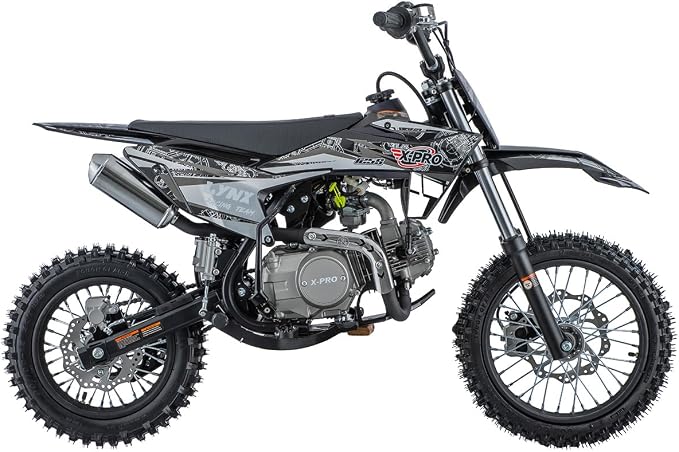
The X-PRO Lynx 125cc is a compact, no-frills trail bike made for unpaved trails. It suits riders moving up from automatic mini bikes who want to learn shifting for real. Its biggest strength is the 4-speed manual clutch, which teaches throttle and gear control properly.
Setting it up means bolting on the handlebar brackets, wheels, brakes, number plate and fender, so check every fastener before the first ride. Starting is all kick, which means no battery to charge and less to go wrong, and the air-cooled Zongshen engine needs no coolant or radiator maintenance.
Once rolling, the four speeds keep a newer rider busy, and gear choice genuinely matters on climbs.
The cradle-type steel tube frame gives the bike a planted, solid feel over broken ground, and the 60/100-14 front and 80/100-12 rear tires add real ground clearance over ruts and roots. Hydraulic disc brakes at both ends bite hard and stay predictable on loose dirt.
The chain drive works well but wants regular lube and tension checks, more upkeep than a shaft setup would ever ask for.
Everyday use is straightforward: the Zongshen 125cc engine starts with a firm kick, the four-speed manual clutch teaches smooth shifting, and the 14 and 12 inch wheels roll over roots and ruts that stop smaller bikes. The chain needs oiling after dusty rides, and the kick starter takes a deliberate stomp on cold mornings.
Riders moving up from a small automatic minibike will feel at home here, since the manual clutch builds real shifting skill and the hydraulic disc brakes respond quickly at trail speeds. Complete beginners, very young kids, or anyone who wants push-button starting should pick a model with electric start instead. Taller riders will want to check seat height before buying.
Assembly covers the handlebar brackets, wheels, brakes, and number plate, so keep basic tools on hand and recheck every bolt after the first rides. Chain tension and tire pressure deserve a glance before each outing. As an off road dirt bike for unpaved trails, it gives newer riders genuine control without an electric start system to maintain.
Pros
- Four-speed manual clutch builds real shifting skills
- Hydraulic disc brakes at both ends
- 14/12-inch wheels boost ground clearance on trails
- Kick start keeps weight down and maintenance simple
Cons
- Kick start only, no electric backup
- Ships partly apart; wheels and brakes need full assembly
| Specification | Details |
|---|---|
| Number of speeds | 4 |
| Suspension type | Front |
| Brake style | Disc |
| Intended riding terrain | Unpaved trails |
| Drivetrain | Chain drive |
9. Rideplux Electric Dirt Bike

The Rideplux Electric Dirt Bike is a full-size off-road machine aimed at adult trail riders. It suits anyone who spends weekends on loose dirt, gravel, and sand and wants power that actually climbs. Its biggest strength is the mid-drive motor, which sits low in the frame and puts 220N·m at the rear wheel.
Day to day, the removable 48V 22.5Ah battery is the part you’ll touch most. It unlocks in seconds, so you charge it at a kitchen outlet instead of parking a dirt bike indoors. Three speed modes let you dial power down for tight, rocky sections and open it up on descents.
The adjustable gyro assist, settable from 15 to 60 degrees, helps you hold balance during slow technical maneuvers. A 15W dual-color LED headlight covers fog and dusk rides.
On the trail, the motor keeps pulls steady on climbs listed up to 45 degrees. The weld-free unibody frame is the standout, spreading impact stress across one piece of high-carbon steel instead of cracking at seams. Inverted hydraulic forks up front and rear spring suspension absorb landings on aggressive descents.
Front and rear hydraulic disc brakes add regenerative braking to recover energy going downhill. Brakes and wheels need a careful check before the first ride, and a spare battery costs extra.
Everyday riding starts with popping the 48V battery out to charge, which takes seconds and spares you from storing the whole bike inside. The mid-drive motor sends 220N·m of torque to the rear wheel, so climbs hold steady on loose ground. Tuning the gyro assist between 15 and 60 degrees takes a few rides before slow-speed balance feels natural.
Experienced trail riders chasing real torque and a centered, low frame are the natural fit here. The zero-weld unibody steel frame spreads impact across one piece, and three speed modes cover tight sections plus open descents. Beginners should pick something else: 5000 peak watts, a 45-degree climb rating, and hydraulic brakes demand judgment a new rider rarely has.
The maker requires a brake, wheel, and component check before the first ride. Regenerative braking claws back energy on descents, stretching each charge on long downhill runs. Spare batteries cost extra, so budget ahead for all-day off-road riding. The dual-color headlight handles dusk and dust; the strobe reads more as a signal than a trail light.
Pros
- 220N·m of rear-wheel torque handles steep climbs
- Battery unlocks in seconds for indoor charging
- Weld-free unibody frame spreads impact stress evenly
- Regenerative braking recovers energy on descents
Cons
- Spare battery sold separately
- Assembly checks on brakes and wheels needed before riding
| Specification | Details |
|---|---|
| Motor | 5000W peak, mid-drive |
| Torque | 220N·m at the rear wheel |
| Battery | 48V 22.5Ah lithium, removable, with BMS |
| Frame | One-piece high-carbon steel alloy, no welds |
| Suspension | Inverted hydraulic front forks, rear spring |
| Tires | 19″/17″ knobby, all-terrain |
10. X7 Electric Dirt Bike for Adults

The X7 is an adult electric dirt bike built around a 5500W peak mid-drive motor, and it suits riders who push dirt trails, gravel roads and steep climbs. Its biggest strength is torque, which pulls hard up hills and out of loose corners.
Charging the 60V 27Ah battery indoors and checking the K58 color display is most of the routine, and the electrical system carries UL 2272 certification. You pick from three speed settings, and the screen shows speed, battery level, mileage and the active mode at a glance. Reverse Assist is the feature you lean on without thinking, backing out of a crowded garage or a tight trailer.
The rated range tops out at 60 miles, though rider weight, pace and terrain all trim that figure.
A mid-drive layout fed by 220 N·m of torque keeps the power where it counts on steep, loose climbs. An inverted hydraulic fork up front and a nitrogen rear shock take the sting out of rocks and ruts.
Hydraulic disc brakes at both ends scrub speed down quickly and predictably, and the 17-inch front and 14-inch rear off-road tires grip uneven ground well. The frame carries riders up to 330 lbs. Climbing and braking are the strong points.
Range is the weak spot, shrinking at higher speeds and on hills.
Daily use is straightforward: the 5500W mid-drive motor and 220 N·m of torque haul you up steep climbs, and reverse assist backs the bike out of tight parking spots. The K58 display keeps speed, mode, and battery visible at a glance. Range runs up to 60 miles per charge, though wide-open throttle on rough trails cuts that down.
Adult riders staying under the 330 lb load rating will be happiest here, especially anyone pushing through loose dirt, gravel, or steep climbs; it ranks among the best off road dirt bike picks for that kind of use. Casual neighborhood riders should choose a lighter, slower ebike, and anyone who mostly commutes on pavement needs a street model instead.
The inverted hydraulic fork and nitrogen rear shock absorb hits from roots and rocks, while front and rear hydraulic disc brakes rein in the 57 mph top speed confidently. The 17-inch front and 14-inch rear tires hook up well on loose ground. Check tire pressure and axle bolts after early rides, and store the battery above freezing.
Pros
- 220 N·m of torque for steep climbs
- Up to 57 mph top speed
- Hydraulic disc brakes at both ends
- Handles riders up to 330 lbs
Cons
- Real-world range falls short of 60 miles at speed
- Rated for unpaved trails rather than street use
| Specification | Details |
|---|---|
| Bike Type | Electric Dirt Bike |
| Power Source | Electric |
| Suspension Type | Dual |
| Brake Style | Disc |
| Number of Speeds | 3 |
| Intended Riding Terrain | Unpaved Trails |
11. Windone RS5 Electric Dirt Bike

The Windone RS5 is a full-size electric dirt bike for adults and teens 13 and up, aimed at dirt trails, fields, and private land. Its single biggest strength is torque: the 2200W peak motor pulls hard up steep hills, which is where most e-bike motors give up.
The shipping box measures 50.5 inches long and weighs 62.14 kg, so get a helper before unpacking. A tool kit is included, and the manual walks you through final assembly.
Day to day, you plan rides around the battery. Windone rates it for up to 45 miles per charge, though real distance moves with rider weight, terrain, and speed. A smart BMS manages charging and discharging, and the UL 2271 certified pack means overnight charging is one less thing to second-guess.
Off-road is where the RS5 earns its keep. The front hydraulic suspension and rear air shock absorb roots, ruts, and hard landings, so the ride stays predictable.
Windone rates the climbing at grades up to 60%, and front and rear hydraulic disc brakes give strong, responsive stops on loose dirt. The trade-off is mass: at 116.2 pounds and 57.1 inches long, it handles trails well but is an awkward lift onto a tailgate, and loading is easiest with two people.
Out on gravel and dirt trails, the RS5 pulls hard thanks to its 2200W peak motor, while front hydraulic forks and a rear air shock soften roots and ruts. The hydraulic disc brakes bite fast on steep descents. The main annoyance is the 116-pound build; hauling it into a truck bed takes two people, so plan where you park it.
Adults and teens 13 and up who ride private land and trails will get the most from this off-road dirt bike, especially hill chasers, since the motor is rated to climb grades up to 60 percent. Younger kids, casual sidewalk riders, or anyone who needs a light bike to carry upstairs are better served by a smaller or lighter model.
Unboxing takes room, since the crate measures 50.5 by 30 by 13.5 inches and ships at 137 pounds. A tool kit and manual come included, and the 48V battery carries UL 2271 certification with a smart BMS managing charge cycles. The listed range tops out at 45 miles per charge, and the one-year warranty softens the risk.
Pros
- Climbs grades up to 60% with steady torque
- Hydraulic disc brakes front and rear stop hard
- UL 2271 battery and UL 2272 vehicle certification
- Front hydraulic suspension plus rear air shock
Cons
- At 116.2 pounds, solo loading is a struggle
- 45-mile range drops with weight, terrain, and speed
| Specification | Details |
|---|---|
| Motor | 2200W peak |
| Battery | 48V 22.5Ah (1080Wh) |
| Range | Up to 45 miles per charge |
| Item weight | 116.2 pounds |
| Tires | 14/12 inch |
| Warranty | 1 Year Warranty |
12. Q1 Electric Dirt Bike

The Q1 Electric Dirt Bike is a mid-drive electric machine built for unpaved trails, best suited to riders who want real speed without a gas engine. Acceleration is its headline strength: 30 mph arrives in 2.59 seconds, and the 4500-watt motor carries on to a 60 mph top speed.
The bike arrives 95% pre-assembled, so setup means attaching the bars and running a full brake and wheel check before the first ride. Charging is straightforward: the 60V/30Ah pack feeds through an automotive-grade BMS with temperature sensors watching it in real time.
The IP67 rating means wet grass and trail puddles are nothing to sweat. 3 speed settings help you keep things tame on tighter trails, and the 14-inch front tire bites into sand and gravel without wandering.
The 4500-watt mid-drive motor is the star. It reaches 30 mph in 2.59 seconds and tops out at 60 mph.
The suspension does real work: the 1.38-inch inverted fork carries 230 mm of travel, and the nitrogen-charged shock allows 6.8 inches of rear-wheel travel for rough trails. Dual-piston hydraulic brakes with forged calipers give a smooth, controlled bite, and the EABS keeps hard braking predictable. One gripe: final assembly is left to you, so a complete brake and wheel inspection has to happen before the first ride.
The bike arrives 95 percent assembled, so setup means finishing the last few steps, checking the brakes, wheels, and fasteners, then charging the 60V/30Ah pack before a first ride. On the trails the listed 60-mile range handles most day trips. The 2.59-second sprint to 30 mph makes fire-road starts feel sharp, and the IP67 battery shrugs off damp, muddy conditions.
Riders with real dirt experience who want a 60 mph machine and have legal places to ride it will be happy here. The dual suspension and 4500 W mid-drive motor suit rough, unpaved terrain. Choose something else for small kids or anyone hoping to ride on public roads, since the listing tells you to check local age and licensing rules.
Specs worth knowing before ordering: a 1.38-inch inverted fork with 230 mm of travel up front, a nitrogen rear shock giving 6.8 inches of rear-wheel travel, plus 14-inch front and 12-inch rear dirt tires. Stopping comes from dual-piston hydraulic calipers with electronic anti-lock assist. The 12-month warranty and extra 24 months of coverage add up to three years total.
Pros
- 0 to 30 mph in 2.59 seconds
- Rides up to 60 miles per charge
- IP67 waterproofing shrugs off mud and wet trail days
- 6.8 inches of rear-wheel travel smooths rough terrain
Cons
- Needs a full brake and wheel check before first ride
- Age and licensing rules vary, so confirm local requirements first
| Specification | Details |
|---|---|
| Motor | 4500 watts, mid drive |
| Battery | 60V/30Ah with BMS |
| Range | Up to 60 miles |
| Top speed | 60 mph |
| Suspension | Dual, 230 mm front travel |
| Brakes | Hydraulic dual-piston with EABS |
Best off Road Dirt Bikes Compared Side by Side
| Product | Engine/Motor | Transmission | Battery & Range | Wheel Size |
|---|---|---|---|---|
| Trailmaster TM38E Dirt Bike | 298cc 4-stroke liquid-cooled | 6-speed manual clutch | – | 21-inch front, 18-inch rear |
| SYX MOTO Pit Bike | 125cc 4-stroke air-cooled | 4-speed manual | – | 17-inch front, 14-inch rear |
| Apollo RFN Thunder 250 | 250cc gas engine | 5-speed manual | – | 21-inch front |
| LIFAN KPX 250 | 250cc fuel-injected LIFAN | 6-speed manual | – | 21-inch front, 19-inch rear |
| Trailmaster LX300 Pro | 283cc water-cooled Zongshen, 23hp | – | – | Kenda 21-inch front, 18-inch rear |
| NEXVEY Flash PRO | 5000W peak mid-drive | – | 60V 27Ah, 55-mile range | – |
| Generic Electric Dirt Bike | 4500W brushless mid-drive | 3-speed | 48V 23Ah, 53-mile range | – |
| X-PRO Lynx 125cc | 125cc Zongshen 4-stroke | 4-speed manual clutch | – | 14-inch front, 12-inch rear |
| Rideplux Electric Dirt Bike | 5000W peak mid-drive | 3 selectable speed modes | – | – |
| X7 Electric Dirt Bike | 5500W peak mid-drive | 3-speed | 60V 27Ah, 60-mile range | – |
| Windone RS5 | 2200W peak motor | – | 48V 22.5Ah, 45-mile range | 14/12-inch tires |
| Q1 Electric Dirt Bike | 4500W mid-drive | 3-speed | 60V/30Ah battery | – |
- Engine/Motor298cc 4-stroke liquid-cooled
- Transmission6-speed manual clutch
- Battery & Range–
- Wheel Size21-inch front, 18-inch rear
- Engine/Motor125cc 4-stroke air-cooled
- Transmission4-speed manual
- Battery & Range–
- Wheel Size17-inch front, 14-inch rear
- Engine/Motor250cc gas engine
- Transmission5-speed manual
- Battery & Range–
- Wheel Size21-inch front
- Engine/Motor250cc fuel-injected LIFAN
- Transmission6-speed manual
- Battery & Range–
- Wheel Size21-inch front, 19-inch rear
- Engine/Motor283cc water-cooled Zongshen, 23hp
- Transmission–
- Battery & Range–
- Wheel SizeKenda 21-inch front, 18-inch rear
- Engine/Motor5000W peak mid-drive
- Transmission–
- Battery & Range60V 27Ah, 55-mile range
- Wheel Size–
- Engine/Motor4500W brushless mid-drive
- Transmission3-speed
- Battery & Range48V 23Ah, 53-mile range
- Wheel Size–
- Engine/Motor125cc Zongshen 4-stroke
- Transmission4-speed manual clutch
- Battery & Range–
- Wheel Size14-inch front, 12-inch rear
- Engine/Motor5000W peak mid-drive
- Transmission3 selectable speed modes
- Battery & Range–
- Wheel Size–
- Engine/Motor5500W peak mid-drive
- Transmission3-speed
- Battery & Range60V 27Ah, 60-mile range
- Wheel Size–
- Engine/Motor2200W peak motor
- Transmission–
- Battery & Range48V 22.5Ah, 45-mile range
- Wheel Size14/12-inch tires
- Engine/Motor4500W mid-drive
- Transmission3-speed
- Battery & Range60V/30Ah battery
- Wheel Size–
How to Pick the Right on off Road Dirt Bike
Engine size, weight, and seat height matter most because they decide how the bike handles pavement, trails, and tight turns. Suspension travel and street-legal gear come next. Matching these to your skill and the road-to-trail split saves money and avoids a bike you end up fighting.
Engine Size and Power
A 350 four-stroke chugs up a rock garden at walking pace, then cruises a 55 mph county road all afternoon. Point the same bike down a 70 mph highway for half an hour and it sits near redline, buzzy, with nothing left for passing.
Displacement decides that. 250 to 350cc keeps a bike light and nimble on tight trails, but regular 70 mph highway time wants a 450 to 650cc motor turning relaxed rpm at speed. An air-cooled, carbureted 400 taught a friend the hard way: idling in summer traffic, it heat soaked and stumbled, and every trip above 6,000 feet meant re-jetting.
Liquid cooling and fuel injection shrug off slow rock crawls and stop-and-go riding, and they adjust to elevation on their own.
Power delivery matters as much as peak numbers. A tractable low and midrange pulls through mud and roots on a steady throttle, while a peaky motor forces constant clutch stabs on narrow singletrack.
Pay attention to where the power arrives, not just the top-end figure.
Suspension Travel and Adjustability
A square-edged rock at speed is the test most bikes fail. Trail-focused dual sports carry 8 to 12 inches of travel front and rear, which is enough to swallow rocks, whoops, and the occasional curb hop without bottoming hard.
Shorter-travel street-leaning models slam through their stroke and send the hit straight to your hands.
Compression, rebound, and preload adjusters are what make one bike work in both places. Soften the fork for rooty trails, click it firmer for a highway run into town. Bikes with a single adjuster or none at all force one compromise setting that serves neither surface well, and you feel it every ride.
Check spring rates against your body weight before buying. A bike valved for a 160 pound rider will wallow through corners and deflect off bumps once a heavier rider climbs aboard or you strap on luggage.
Respringing is a real cost, so buy close to your weight from the start.
Weight and Seat Height
A 320-pound dual sport lying sideways across a rutted hillside is a problem you feel in your lower back first. Wet weight between 250 and 350 pounds is typical in this class, and every extra 30 pounds shows up the moment you have to lift a dropped bike, boots sliding in the loose dirt.
Seat height matters just as much at stop signs. Straddle the bike in riding boots and aim to touch the ground with the balls of both feet.
A 37-inch seat on a 30-inch inseam leaves you tiptoeing at every light, and that gets tiring fast. Picking 33 inches over 37 turns low-speed control into something calm instead of a balancing act.
Where the mass sits counts for a lot as well. A narrow seat and a fuel tank mounted low drop the center of gravity, which steadies the bike at walking pace and in tight switchbacks. Two bikes can carry the same spec-sheet weight and feel completely different while idling through rocks, so sit on both before deciding.
Street Legal Gear and Tires
A friend bought an off-road model, rode it home, and got stopped two blocks from the dealer because it had no mirrors and no horn. Some bikes arrive road ready with DOT-approved lights, mirrors, a horn, and a plate mount fitted. Others come bare, so figure on a plating kit, an inspection, and paperwork before the DMV issues a plate.
Tread decides where the bike feels at home. A 50/50 tire wears slowly on asphalt and still holds gravel, while a 90/10 knobby digs into soft dirt, then turns twitchy, loud, and greasy at 65 mph on the highway.
Road miles eat knobs about twice as fast, so a rear tire can be spent in one summer.
Used bikes hide tire age, so press a coin into a knob. Fresh rubber dents and springs back. Old rubber barely gives, and it slides on wet pavement even with tread that still looks fine.
Treat a hardened rear tire as your first expense on a used purchase, before anything fun.
Fuel Range and Maintenance
A 2.0-gallon tank with a printed 88 mpg figure reads like 170 miles. Real riding with a packed gear bag and two-track climbs lands in the mid-50s, so true range sits closer to 110.
Multiply tank size by what your trip meter actually shows, then hold back a margin for cold starts and mud. Past roughly 100 honest miles per fill, remote loops stop feeling like a fuel-management exercise.
Valve check intervals vary widely between engines. Some singles call for the first inspection before 1,000 miles, a job that means shop labor unless you turn your own wrenches.
Others stretch the interval out for years. Bake that schedule into ownership costs before you compare sticker prices.
Fuel injection earns its keep in storage. A carbureted bike wants the bowl drained before winter and fresh jetting for big elevation swings, and it sulks on cold starts until you clean the pilot circuit. An injected bike adjusts itself and usually lights off after months in the shed.
How to Break in and Care for a Dual Sport Bike After the First Ride
The first few rides matter more than the first ride itself. Piston rings seat and clearances settle over several heat cycles, so keep the throttle below three quarters and vary your speed instead of holding one steady rpm. Avoid lugging the motor in a tall gear, and let the engine cool fully before shutting off after a long climb.
Check fluids and fasteners after every outing for the first month. New bikes shed torque from bolts, spokes, and chain adjusters fast.
- Change the oil early. Most manuals call for the first service between 300 and 500 miles, and metallic glints on the drain plug magnet show why.
- Set chain tension and lube it after each ride; a new chain stretches quickly.
- Re-torque axle, handlebar, and footpeg bolts to spec once the engine has a few heat cycles on it.
Wash the bike, let it dry completely, then lube the chain. Moisture trapped under fresh mud causes corrosion faster than most riders expect.
Common Maintenance Mistakes That Leave Dual Sport Riders Stranded
Common Maintenance Mistakes That Leave Dual Sport Riders Stranded
A dry chain causes more trailside breakdowns than any other failure, and it rarely happens without warning. Water and grit strip lubrication fast, so a chain that felt fine at the trailhead can start clattering before the ride ends.
The rest of the list follows the same pattern: small jobs skipped because the bike ran fine last weekend.
- Ignoring chain slack. Vibration pulls it out of spec quickly. Most swingarms have a sticker with the factory measurement; check it every few rides.
- Wrong tire pressure for the terrain. Low pressure grips on soft dirt but overheats the casing on pavement. Carry a compact gauge and a small pump.
- Riding with a dry air filter. One dusty day without filter oil sends grit straight into the engine.
- Loose fasteners. Spokes, lever mounts, and axle nuts back off after rough rock sections.
Ten minutes with chain lube, a rag, and a gauge prevents almost every ride home on a trailer.
Dual Sport vs Enduro: Picking the Right Bike for Your Terrain
Weight is the quickest way to separate these two bikes. A Honda CRF300L weighs about 309 pounds wet, while a KTM 300 XC-W runs closer to 240.
Nearly 70 pounds makes a real difference halfway up a rocky climb when the bike stalls and you have to heave it around.
A dual sport makes sense once pavement enters the picture:
- You link trail systems with stretches of country road.
- The bike doubles as a commuter, complete with mirrors, a plate, and a tank big enough for the ride home.
- Longer service intervals and softer suspension suit slow, all-day exploring.
An enduro earns its money in tight terrain:
- Singletrack, rock ledges, and repeated hill climbs define the ride.
- Longer travel and firmer damping absorb hits a dual sport flinches at.
- Close-ratio gearing keeps the engine on the pipe in the woods.
One check before you buy: many race-spec enduros lack DOT lighting, so confirm your state will plate one or plan on a trailer.
People Also Asked
How Often Should I Change the Oil on a Dual Sport Bike?
Plan on an oil change every 1,000 to 1,500 miles, or after every third or fourth hard gravel ride, whichever comes first. Dual sport engines are small and work hard, especially on long pavement stretches where single-cylinder air-cooled motors run hot. Check the level on the center stand each weekend; these bikes can burn a little oil over time. Dusty rides call for changing it sooner.
What Size Dirt Bike Is Right for a Beginner Adult Rider?
Most beginner adults should start with a 250cc four-stroke trail bike with a seat height around 34 to 37 inches, so both feet can touch the ground at stops. Heavier riders over 200 pounds often find a 230cc model underpowered and may want the extra torque. Sit on a few models before buying, since a bike even an inch too tall makes hill starts and log crossings stressful.
Can I Ride a Dirt Bike Plated for the Street Legally?
A plated dirt bike is legal on public roads in states that issued it a title and plate. Most states require a headlight, brake light, horn, mirrors, and a motorcycle endorsement on your license. California is strict about emissions, so a two stroke may never pass there. Annual registration and insurance run cheap, and many riders carry a small toolkit for checking bolts after hard trail days.
How Long Does a Four Stroke Dirt Bike Engine Usually Last?
Most four-stroke dirt bike engines last between 100 and 300 hours before a rebuild, depending on how hard you ride. Racing at high rpm can wear a piston in 50 hours, while trail riding goes easier on parts. Change the oil every 5 to 10 hours and keep the air filter clean, because dirt ingestion kills engines faster than anything else.
Why Does My Dirt Bike Bog Down When I Open the Throttle?
A bog when you open the throttle usually means the engine is running lean, most often from a clogged pilot jet or gummed-up carb. Pull the carb, spray cleaner through the pilot circuit, and check the jet’s tiny holes under a light. Try riding with the choke partway on. A bog that fades with choke confirms a fuel delivery problem. Fresh gas and a clean air filter help too.
Conclusion
Three things decide most purchases. Fit comes first: seat height and weight need to match the person holding the bike up at stops. Engine size matters next, since a 125cc trail bike and a 450cc motocross machine suit very different skill levels.
Budget should cover gear, fuel, and oil changes, not just the sticker price.
Match the bike to how often you will ride. A weekend trail rider does not need race-level power, and a beginner gains more from a lighter, cheaper machine.
Scroll back to the comparison table and the picks above to narrow your list.
